Monday, 12 September 2011

Competency 3

[HOME]


Tools labelling


Precautions
  1. Tools must be handled with care as they get easily damaged if not properly used.
  2. All sharp tools must be safely handled.
  3. Tools –particularly tools with pointed ends or having a cutting edge--must never be kept in the pocket.
  4. Tools must be cleaned and put back in the tool box after use.


TRY-SQUARE (écaire)
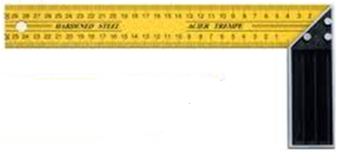


Used for:
1.       Checking flatness of surface/s
2.       Checking squareness of adjacent edges
3.       Marking perpendicular


SPIRIT LEVEL (Niveau à bulle)


A spirit level or bubble level is an instrument designed to indicate whether a surface is horizontal (level) or vertical (plumb). Different types of spirit levels may be used by carpenters, stone masons, bricklayers, other building trades workers, surveyors, millwrights and other metalworkers, and in some photographic or videographic work.


COMBINATION PLIERS (Pinces multifonctions)


A typical set of pliers are designed with two handles that are hinged together and connected to a toothed jaw that is used for gripping objects. Combination pliers have these characteristics, but are also created with one or more additional built-in tools that can be utilized for a wider variety of purposes. 


WIRE STRIPPERS ( Pinces à dénuder)


When an electrician needs to repair a wire, he or she may use a pair of wire strippers. A tool that resembles a pair of pliers in appearance, wire strippers enable a worker to cut the protective coating (insulation) off an electrical wire. This must be done before repairing or replacing most wires.


CABLE KNIFE (Cutter)


Used for removing sheath of cables


MEASURING TAPE (Trèsse à mésurer)


A tape measure or measuring tape is a flexible form of ruler. It consists of a ribbon of cloth, plastic, fiber glass, or metal strip with linear-measurement markings. It is a common measuring tool. Its flexibility allows for a measure of great length to be easily carried in pocket or toolkit and permits one to measure around curves or corners


SIDE CUTTING PLIERS (Pince coupante)


Diagonal pliers (or wire cutters or diagonal cutting pliers) are pliers intended for the cutting of wire (they are generally not used to grab or turn anything).

SCREWDRIVER (Tournevis)


A screwdriver is a tool for driving screws and rotating other machine elements with the mating drive system.


LONG NOSE PLIERS(Pinces à long bec)


Needle-nose pliers (also known as long-nose pliers, pinch-nose pliers, or snipe-nose pliers) are both cutting and gripping pliers used by electricians and other tradesmen to bend, re-position and cut wire. Given their long shape, they are useful for reaching into cavities where cables (or other materials) have become stuck or unreachable to fingers or other means.


JUNIOR HACK SAW( Scie)


Junior hacksaw used to cut accessories to provide entry for cables or trunking and soft metals.


ELECTRICIAN HAMMER (Marteau)


Electrician hammer used for driving nails and rawl plugs.


Friday, 9 September 2011

Competency 8

[HOME]

8.1 State the purpose of a consumer’s unit.

The purpose of the consumer unit is to house the different components used:-
1.     Isolation of the consumer unit from the supply.
2.     Protections for Circuit segregation (separation)


8.2 List the standard sizes of main cables entering a consumer’s unit.

The standard sizes of main cables entering a consumer’s unit are:
1.      6 mm2
2.      10 mm2


8.3 State the common ratings of main fuse/circuit-breaker likely to be     found in a consumer's unit installed in domestic premises.

Ratings depend on the total maximum load of the outgoing circuits.


Ratings of main fuses
  1. 45A
  2. 60A

Ratings of main circuit breakers


  1. 40A
  2. 45A
  3. 63A
  4. 100A

8.4 List the standard size of fuse likely to be found in a consumer’s unit.


Fuse
Colour
Typical Uses
5 amp
White
Lighting / small plug circuits
15 amp
Blue
Immersion/storage heaters
20 amp
Yellow
Smaller radial circuits / water heaters
30 amp
Red
Ring circuits (sockets), cookers, showers, radial circuits
45 amp
Green
Cookers/showers


8.5 Interpret the colour code of fuses.


Consumer unit with fuses


Colour -code for rewirable fuses


Rewirable fuses


Consumer unit with Circuit Breakers 

Note: Circuit breakers are replacing fuses as the latter are becoming obsolete.
Regulations recommend that New buildings must be equipped with these devices and at least a RCD.  


Ratings of outgoing circuit breakers


Circuit breaker
Typical Uses
6 amp
Lighting
10 amp
Lighting / small plug circuits
16 amp
Immersion/storage heaters
20 amp
Smaller radial circuits / water heaters
25 amp
32 amp
Ring circuits (sockets), cookers, showers, radial circuits
40 amp
45 amp
Cookers/showers


MAIN SWITCH


Competency 7

[HOME]

Competency 7- Wiring of plugs

7.1 List different types of flexible cords commonly used in domestic
Premises.

Types of flexible cord
Insulation
Sheath
PVC
PVC
Rubber
Rubber


7.2 Differentiate between a flexible cable and flexible cord.


Difference between flexible cord and flexible cable.

Flexible cord
Flexible cable
conductor size less than 4mm2
conductor size of 4mm2 and greater than 4mm2


7.3 Interpret the colour code for the cores of a flexible cord.


3-Core Cable


Live
Brown
Neutral
Blue
Earth
Green/Yellow


7.4 State the need for soldering multi stranded conductors.

Ø  To bring the strands in a single “hard” core so as to avoid breakage of the strands ( brins) while tightening connections.

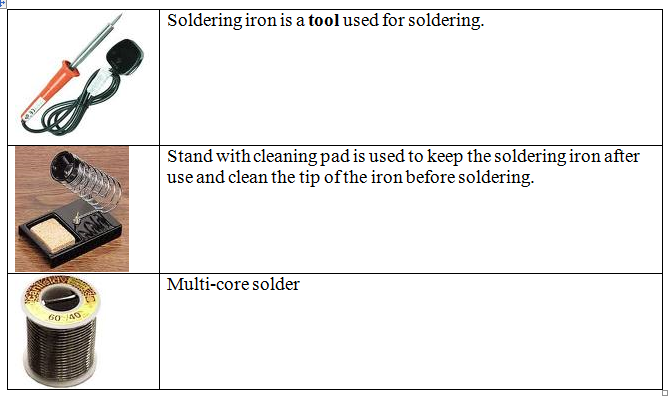
7.5 List the tools and materials required for soldering. 


7.6 State the importance of connecting an earth conductor in a 3-pin  plug.

Ø To provide a path to ground in the presence of a fault or leakage current in the connected equipment. Thus protecting the user from electric shock. 

7.7 State the precautions to be taken when connecting a cotton braided flexible cord to a 3-pin plug.

1.     Avoid damaging the insulation of the cores when removing the cotton fabric and sheath.
2.     The cotton braid must be properly taped or laced.
3.     Avoid damage to strands (brins) while removing insulation.
4.     The laced end of the cord must be firmly held using the cord or cable grip.
5.     Colour code must be observed.
6.    All connections must be properly tightened.


3-Pin Plug

Competency 6

[HOME]


CARRY OUT WIRING FOR A RADIAL SOCKET-OUTLET CIRCUIT

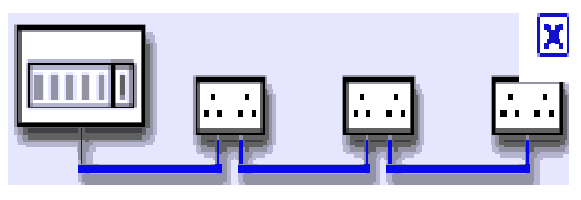
6.1 Explain a radial final circuit by drawing the circuit diagram

·        A radial final circuit.

6.2 State the meaning of the following terms:-
(1)     Fixed equipment:
Electrical equipment designed to be fastened to a support or otherwise secured in a specific location. 
          (Example: Bench drill, fumes hoods, wall fans, security systems)

(2)              Stationary equipment:
Stationary equipment is one that is permanently connected to a final circuit. Example: an electric cooker, washing machine.

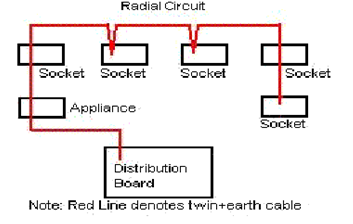
6.3 Sketch the method of connecting equipment to a radial circuit


 6.4 Identify different types of RCDs
RCDs are designed to prevent electrocution by detecting the leakage current, which can be far smaller (typically 5–30 milliamperes) than the currents needed to operate conventional circuit breakers or fuses (several amperes). RCDs are intended to operate within 25-40 milliseconds, before electric shock can drive the heart into ventricular fibrillation, the most common cause of death through electric shock.

 6.5 State the limitations of RCDs

Limitations of RCDs.
Residual current detection is complementary to over-current detection. Residual current detection cannot provide protection for overload or short-circuit currents.


   6.6 State the requirements of the Electricity Act in Force
       in Mauritius in respect to RCDs
An RCD should be installed on the incoming supply. Rating of RCD should be 40A or 63A  (or if more than one has been installed rating to be equivalent to maximum circuit loads connected to the RCD) and the rated trip current 30mA.

6.7 List the safety precautions to be observed while installing a radial circuit.

·                                                                      Polarity and color code must be respected.
·                                                                      Appropriate size of cables should be used.
·                                                                      Appropriate ratings of circuit breaker should be used.